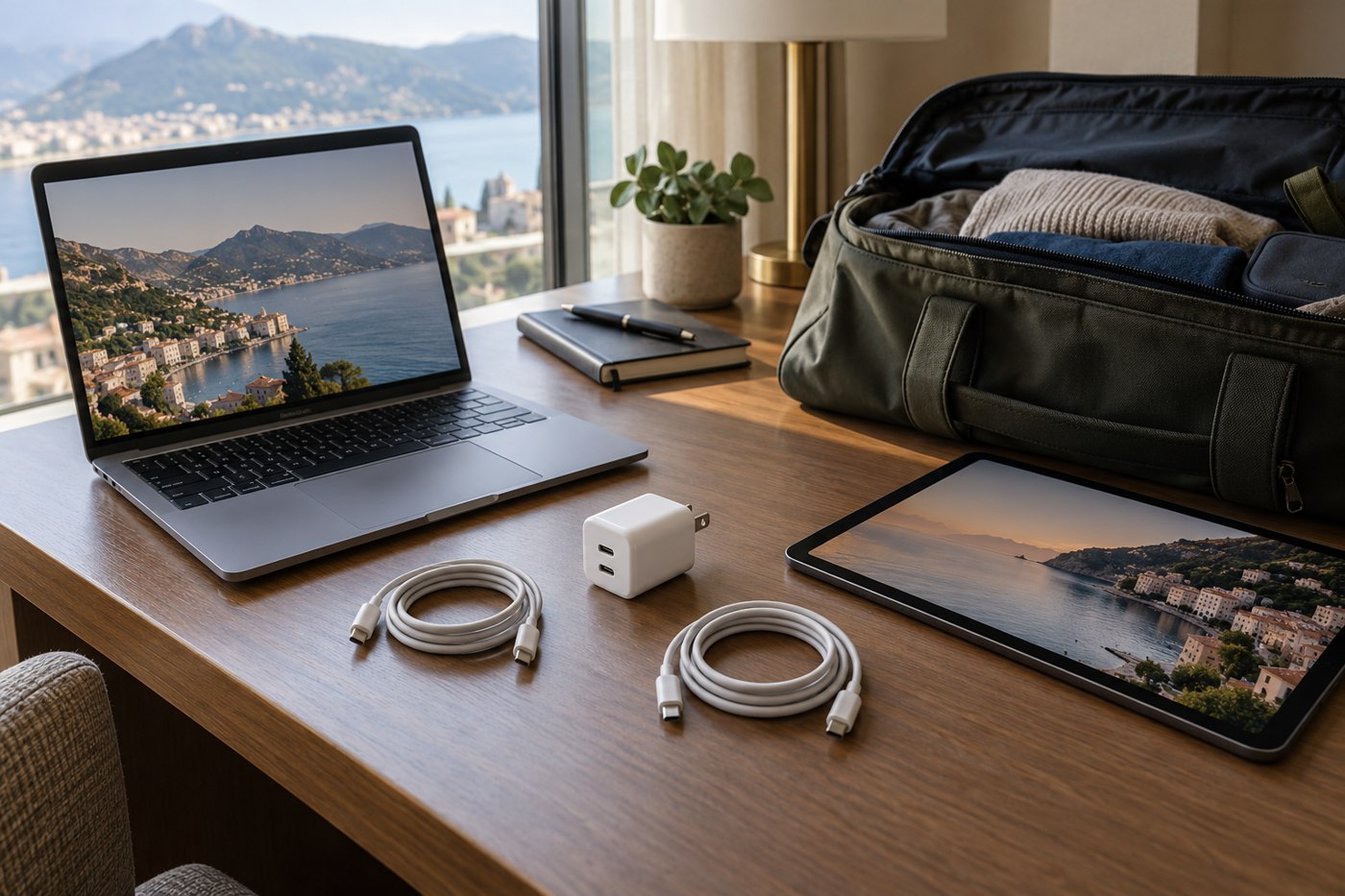
Start with the tablet and laptop manufacturers' charging requirements. Then decide when both devices need power: overnight, during a short stop or while you are actively working. The same charger can be convenient in one schedule and limiting in another.
If you choose a multiport adapter, read the output allocation for the exact two-port combination. The maximum printed on the charger may not be available to the laptop while the tablet is connected. Include the cables' supported capabilities and the ports used, rather than comparing only the total wattage.
Think in sessions
For overnight charging, your priorities may be different from a brief airport stop. During a short break, identify which device needs enough energy for the next task. Do not assume charging both simultaneously is always the most useful arrangement; follow the supported options and your actual schedule.
If the laptop will run a demanding task while connected, use its manufacturer's guidance to assess the adapter arrangement. A tablet charging indicator does not tell you whether the shared output remains appropriate for the computer.
Check the destination connection
Read the adapter's input specification and the plug requirements for the destination. A physical plug adapter does not necessarily convert voltage. Use documented compatible equipment and avoid assembling a loose chain of travel adapters.
Measure cable reach in the kinds of spaces you expect to use. Keep the power supply uncovered and operated within its instructions. A bag can hold the kit during travel without being the right place to run it while charging.
Rehearse the complete kit
At home, connect both devices with the leads that will travel. Check the charging indications and the response when one device is removed or added. Consult the charger documentation about any redistribution behaviour rather than treating every change as a fault.
Keep essential model information available if you may need support away from home. Consider a known suitable fallback only where the trip justifies it; carrying every old charger is not a substitute for a tested plan.
Before leaving a room or seat, check the outlet and cable route as well as the devices. Small adapters are easy to leave behind when the laptop has already been packed. A consistent packing order can protect the kit more effectively than adding another unidentified spare.
Make a simple evening-and-morning plan
Consider a hypothetical trip with a laptop used at an afternoon meeting and a tablet used for reading on the return journey. Identify which device must be ready first. Check whether the documented shared-port arrangement meets both needs or whether charging one before the other is a more predictable plan. The answer depends on the actual equipment and available time, not simply on the number of sockets.
Include the time needed to recharge a portable power bank if it is part of the kit. It is another receiving device with its own input requirements, not an invisible source of energy that is always full. Avoid planning an uninterrupted chain of charging tasks without checking the equipment's supported simultaneous-use behaviour.
At packing time, keep each device's essential lead accessible and check that the destination plug arrangement is complete. A verified charger left in the wrong bag is functionally absent during a short stop. A small list tied to the devices you are carrying is more useful than a large universal kit that contains several redundant cables but misses the one required for the laptop.